Most people think lidar mapping simply means scanning land with lasers and turning it into a 3D model. For many years, that description worked. However, the biggest change today is not in how data gets captured — it’s in how data gets understood.
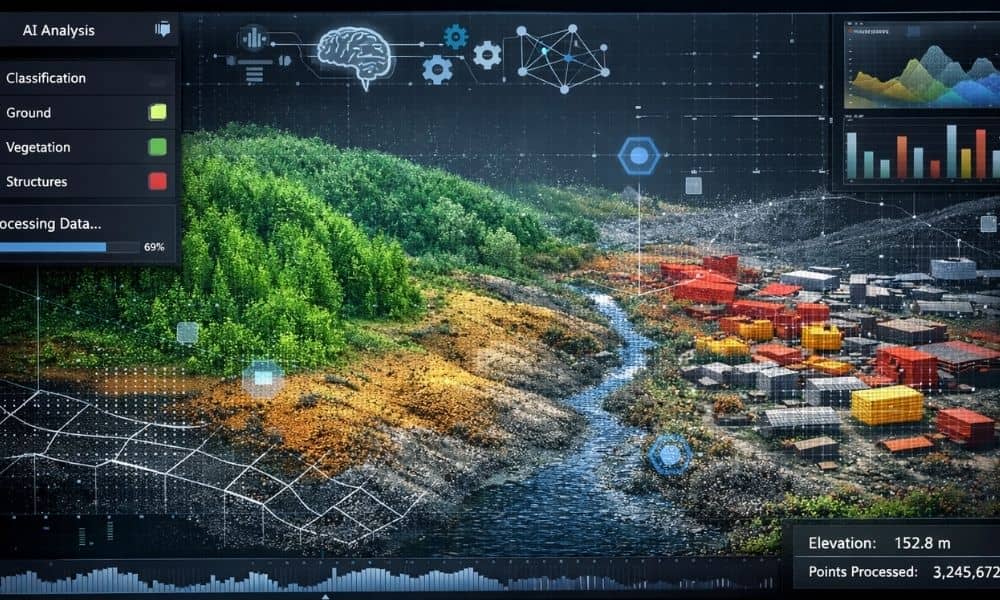
Lidar mapping has started moving into the AI era. That shift changes how fast terrain models get built and how useful site data becomes early in a project. Instead of waiting days or weeks for cleaned and sorted results, teams can now see clearer ground models much sooner.
So if you own land, plan development, or manage design work, this change affects you more than you might think.
Lidar Mapping Used to Be Captured First, Understanding Later
In the past, lidar mapping followed a slow pattern. First came the scan. A drone or aircraft collected millions of elevation points. After that, processing teams stepped in. They sorted ground points from trees, buildings, and random noise. Only then could they build terrain models and contours.
That process worked well, but it often created a gap between field work and usable answers. Clients received data files quickly, yet they waited longer for decision-ready terrain models.
Meanwhile, complex sites made things worse. Heavy vegetation, steep slopes, and mixed surfaces created messy point clouds. Technicians needed extra time to clean and classify those areas. As a result, early planning sometimes moved forward with partial information.
Now, that delay is shrinking.
AI Changes How Lidar Data Gets Interpreted
Today, modern lidar mapping software uses AI-assisted processing to speed up interpretation. Instead of treating every new dataset like a blank slate, the software draws from trained pattern models. It recognizes shapes, density, and height behavior across the scan.
In simple terms, the system can make smart guesses about what belongs to the ground and what does not.
For example, it can spot likely vegetation clusters and separate them from terrain faster than older rule-based filters. It can also flag strange points that do not match nearby surfaces. Because of that, the first processed version of the dataset already looks cleaner.
Even so, professionals still review and correct the results. AI speeds the first pass — it does not replace expert judgment. That balance matters for quality.
Terrain Extraction Happens Faster Than Before
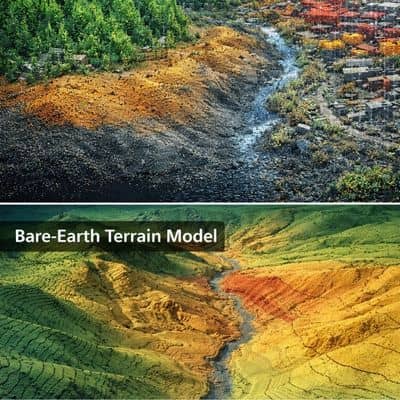
Most clients care about one main output from lidar mapping: the true ground surface. Everything from grading plans to drainage checks depends on that terrain layer.
However, trees and structures often block the ground signal. Older workflows removed those obstacles through careful manual filtering. That step took patience and time.
Now AI-assisted classification recognizes vertical patterns and surface continuity much more quickly. It sees how ground behaves compared to leaves, branches, and rooftops. Therefore, it strips away many non-ground points earlier in processing.
Because of that improvement, teams can produce draft terrain models sooner. Designers and planners get an earlier look at slopes, low areas, and surface flow. Consequently, early feasibility decisions become more informed.
Point Clouds Need Less Heavy Cleanup
Raw point clouds often contain clutter. You might see floating points, stray returns, and rough edges. In the past, technicians cleaned those areas point by point. That work required skill, but it also required hours.
Now AI-assisted filters remove much of that clutter automatically. They detect outliers based on spacing and height behavior. They also group surfaces more consistently across the site.
As a result, specialists spend more time reviewing and refining instead of starting from scratch. That shift improves consistency across the dataset and reduces processing bottlenecks.
From a client perspective, this often shows up as steadier turnaround times and fewer revision cycles.
Deliverables Become Useful Earlier in the Project
This AI shift does not just help technicians — it helps clients directly. When lidar mapping processing speeds up, useful deliverables arrive earlier.
Draft terrain models come together faster. Contour lines show fewer odd spikes. Surface models stabilize sooner. In addition, repeat scans line up more easily for change comparison.
That earlier clarity supports better early-stage planning. Teams can review slope behavior, drainage direction, and grading needs without waiting for extended cleanup cycles. Therefore, project discussions move forward with stronger data on the table.
Speed alone is not the only benefit. Consistency also improves. AI-assisted processing applies the same pattern logic across the whole site, which reduces uneven classification between sections.
Complex Terrain Shows the Biggest Improvement
Flat open land already processes fairly well under older methods. However, difficult terrain shows the biggest gains from AI-assisted lidar mapping.
Wooded parcels, broken slopes, and mixed ground cover used to slow everything down. Vegetation overlapped terrain returns. Sharp elevation changes confused simple filters. Manual correction filled the gap.
Now pattern-trained models handle those environments more smoothly on the first pass. They recognize how forest canopies differ from ground texture. They also read slope transitions more reliably.
That does not remove the need for review. Still, it gives experts a much better starting point. Consequently, complex sites no longer guarantee slow processing.
Technology Still Needs Professional Oversight
Even with AI in the workflow, lidar mapping still depends on professional control and review. Software can suggest classifications, but it cannot take responsibility for accuracy.
Qualified experts still verify coordinate control, vertical alignment, and surface logic. They check whether the terrain model fits the project purpose. They also confirm that outputs meet required standards.
This human layer protects clients. It ensures that faster processing does not lead to careless results. In practice, the best outcomes come from combining smart tools with experienced reviewers.
What This Shift Really Means for Clients
All of this change leads to one practical result: better answers arrive sooner. Lidar mapping in the AI era moves from raw data toward usable terrain insight more quickly than before.
That helps property owners evaluate sites earlier. It helps design teams reduce guesswork. It helps planners spot surface risks before they grow into redesign costs.
In other words, smarter processing supports smarter early decisions.
Lidar mapping will keep evolving. However, the goal stays the same — clear, reliable terrain and site data. Now, with AI-assisted workflows, reaching that goal simply takes less time and fewer cleanup cycles than it used to.