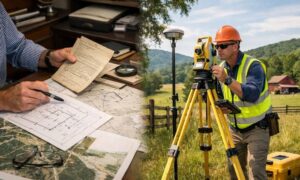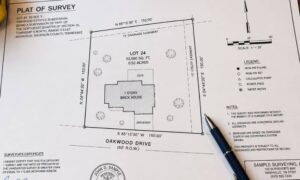
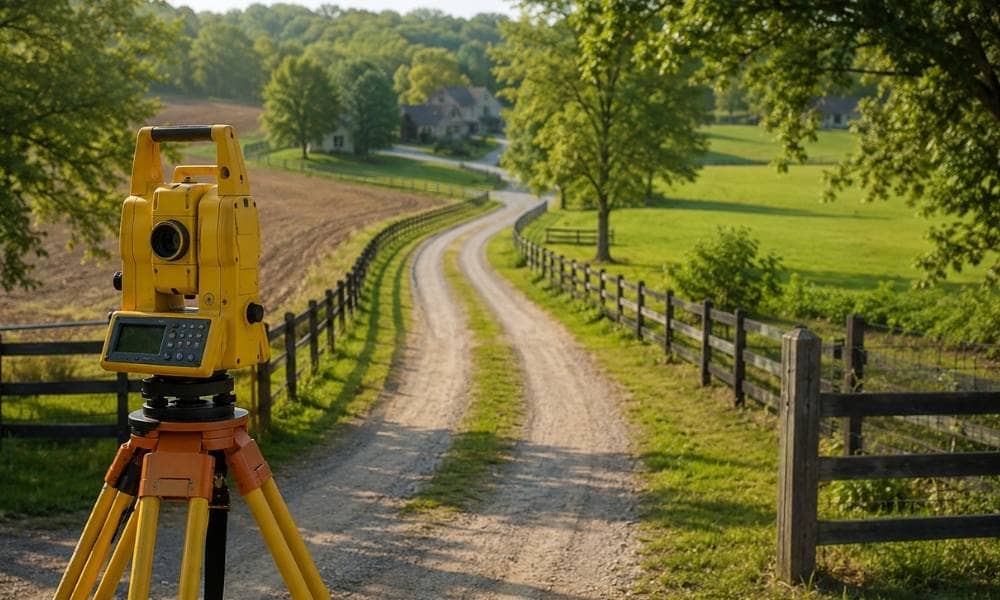
Shared private roads cause more disputes than most property owners expect. A fence goes up two feet too far. A gravel pad creeps into the turnaround. Nobody notices until the next neighbor cannot get a delivery truck through. Survey mapping fixes this problem before it starts. It shows the exact path, width, and boundaries of the road everyone depends on, so each owner knows what they are working with.
For developers managing parcels with shared access, this is not a small detail. It is the line between a smooth project and months of stalled permits.
Why Survey Mapping Matters for Properties That Share a Private Road
When two or more properties rely on the same private lane, everyone needs to know where that lane actually sits. Survey mapping records the precise location, width, and centerline of the road. It shows where the gravel ends and where each owner’s land begins.
This matters most during site planning. A developer laying out lots, utilities, or drainage near a shared road needs hard numbers, not guesses based on an old fence line or a neighbor’s memory. Survey mapping gives those numbers.
Here is what accurate road mapping typically confirms:
- The legal width of the travel surface
- The centerline path across each parcel
- Any turnouts, pull-offs, or shared parking areas
- Grade changes that affect drainage or vehicle access
- Points where the road crosses property lines
Without this record, two neighbors might have two different ideas about how wide “the road” is supposed to be. That gap causes problems fast, especially once construction equipment needs to pass through.
How Survey Mapping Identifies Encroachments That Can Restrict Road Access
Encroachments rarely happen all at once. A fence post goes in a little too close. A retaining wall gets built a foot over the line. A homeowner parks a trailer on what they think is their yard. Over a few years, the usable width of a shared road can shrink without anyone meaning to cause it.
Survey mapping catches these issues early. By comparing the current ground conditions to the recorded road boundaries, a surveyor can flag:
- Fences or hedges that cross into the roadway
- Retaining walls or landscaping beds built too close to the travel surface
- Sheds, equipment, or vehicles stored within the mapped right-of-way
- New structures placed near the road without checking the original layout
For developers, this step is worth doing before any construction phase. If heavy equipment cannot fit through a shared lane because of an encroachment, the delay falls on the whole project, not just the property causing the problem. Catching it on a map is far cheaper than catching it with a stuck delivery truck.
Using Survey Mapping to Support Road Maintenance and Improvement Planning
Shared roads need upkeep. Gravel wears down. Drainage shifts after heavy rain. Culverts clog. At some point, someone has to plan a fix, and that fix needs to stay inside the road’s actual footprint.
Survey mapping gives contractors and property owners a clear reference for these projects:
- Gravel replacement or resurfacing stays within the mapped travel lane instead of spreading onto neighboring yards.
- Drainage improvements can be designed around the road’s real grade and elevation, not a rough estimate.
- Culvert installation can be placed at the correct point along the road without guessing where the right-of-way ends.
- Road widening can be checked against the legal boundary before any digging starts.
This kind of planning protects everyone involved. Property owners are not at risk of work spilling onto land they do not own, and contractors are not stuck halfway through a job because the boundary turned out to be somewhere else. For multi-lot developments, where shared lanes often serve several future homesites, this kind of accuracy keeps the road improvement on schedule.
How Survey Mapping Helps New Property Owners Understand Shared Access Responsibilities
Buying a property served by a private road comes with questions. Where does the road actually run? Who maintains which section? What happens if part of it needs repair?
Survey mapping answers the first question clearly: it shows the road’s layout, width, and path across each parcel before the sale closes. That gives a buyer something concrete to review instead of relying on what the seller remembers or what looks obvious from the driveway.
This matters for developers selling lots with shared access. A buyer who sees a clear, mapped layout of the roadway is less likely to come back later with confusion about where their access rights begin and end. It also reduces friction during closing, since the physical layout matches what is described in the paperwork.
Why Survey Mapping Creates a Reliable Record for Future Property Changes
Properties change hands. Improvements get made. New owners ask questions that nobody on site can answer from memory. A mapped record of the shared road solves that problem for the long term.
Once survey mapping documents the road’s location and physical features, that record stays useful for years. It becomes the reference point when:
- A property sells and the new owner wants to confirm access details
- An addition or improvement is planned near the road
- A dispute arises over maintenance responsibility or usage
- A second phase of development needs to tie into the existing road layout
For developers working in phases, this record is especially valuable. Phase two cannot rely on guesswork about where phase one’s road sits. The mapped record gives every future phase a fixed, dependable starting point.